Research Solutions
Study customization
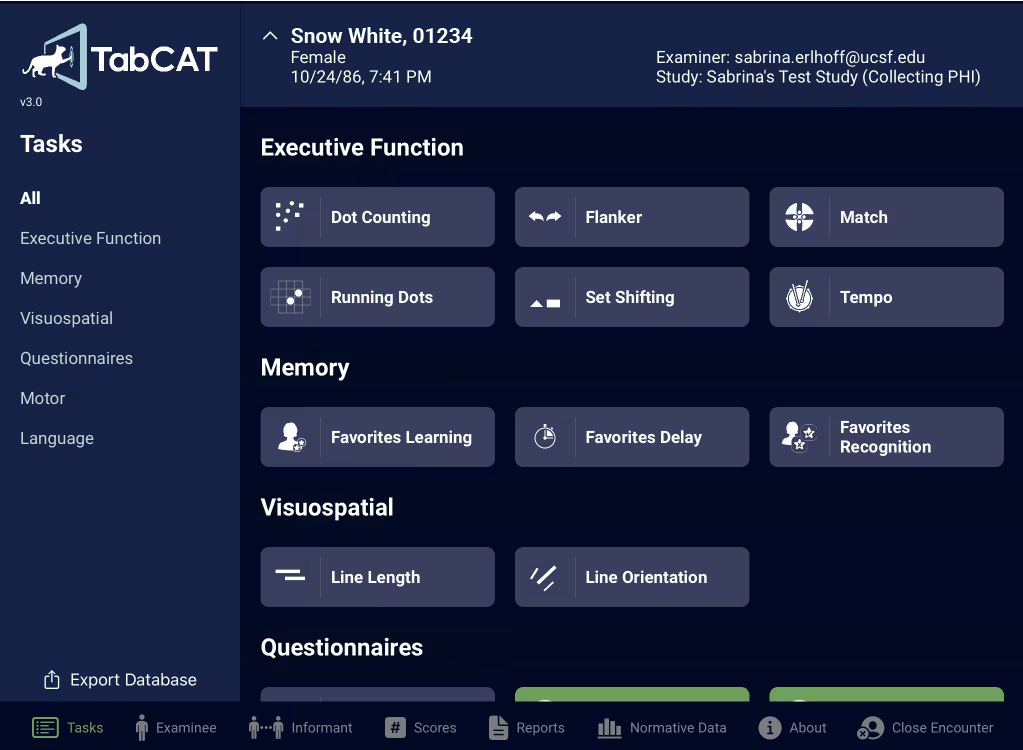
Create a battery of TabCAT tasks that fits your study design, manage sites and user permissions, and collect the data that you need to do your best work.
Automated scoring
TabCAT task advantage of modern digital data capture with comprehensive results that include automated scoring, trial-level reaction times, and metadata.
Long-term data storage
All of your study data is stored in aggregate, ready to be reviewed or downloaded from our admin portal by your designated study personnel any time.
A wealth of available resources
Access a diverse set of resources with you that have been developed by experts to help you design your study and interpret results, including task and score development details, administration manuals, data dictionaries, IRB guidance, and more.
TabCAT Publications
The TabCAT-BHA and other tools are supported by several publications demonstrating reliability and validity.
TabCAT Research Partners
The Multi-Partner Consortium to Expand Dementia Research in Latin America (ReD-Lat) is a multinational consortium aimed at studying genetic and social determinant risk factors for Alzheimer’s disease (AD) and frontotemporal lobar degeneration (FTLD) spectrum in Latin America.
The Multi-Partner Consortium to Expand Dementia Research in Latin America (ReD-Lat) is a multinational consortium aimed at studying genetic and social determinant risk factors for Alzheimer’s disease (AD) and frontotemporal lobar degeneration (FTLD) spectrum in Latin America.
Dr. Mbakile-Mahlanza and her team are investigating whether and how neuropsychological measures from TabCAT can be used for diagnosis of dementia in Botswana.
The Multi-Partner Consortium to Expand Dementia Research in Latin America (ReD-Lat) is a multinational consortium aimed at studying genetic and social determinant risk factors for Alzheimer’s disease (AD) and frontotemporal lobar degeneration (FTLD) spectrum in Latin America.
This study evaluates and compares the impact of an Amazonian Dance protocol on brain health and executive functioning in underrepresented people with Parkinson's Disease from Northern Brazil.
This study evaluates and compares the impact of an Amazonian Dance protocol on brain health and executive functioning in underrepresented people with Parkinson's Disease from Southern Brazil.